2. Evidence (Guideline) Concordance — Evaluation Notebook
Purpose: Evaluate evidence (guideline) concordance by comparing model recommendations against a versioned, case‑specific guideline answer key using exact‑ID and semantic matching, with transparent audit trails and summary metrics.
Date: 10/16/2025
Author: Ishaan Kejriwal
2.1. Overview
Load a gold evidence key of guideline-aligned recommendations for each test case.
Load model outputs containing the system’s predicted recommendations and any cited guideline IDs.
Load a concept map linking aliases or synonyms (e.g., “ACE inhibitor”) to canonical guideline IDs.
Perform exact-ID and semantic matching between model recommendations and guideline standards.
Assign a categorical label (Exact, Semantic, For-consideration, or Not) and compute scores (binary, three-bucket, or weighted).
Summarize results as overall concordance rates and mean scores, generate basic visualizations, and export JSON/CSV audit tables for transparent review.
2.2. Metric Definition
What we check:
Whether the model’s recommendation matches a reference guideline ID or approved equivalent.
Exact-ID matches (model cites the correct guideline or equivalent).
Semantic matches (model uses a correct recommendation phrase or synonym mapped to the guideline).
For-consideration cases (related but less precise or lower-evidence recommendations).
Detection of non-concordant outputs that contradict or omit the guideline.
Recommended summary KPIs:
% cases concordant (Exact + Semantic)Mean weighted concordance scoreDistribution of label categories (Exact / Semantic / For-consideration / Not)(Optional)
Per-guideline or per-condition concordance rates
Suggested pass criteria (tunable):
≥ 90%of cases show Exact or Semantic concordanceMean weighted concordance score
≥ 0.85Minimal (<5%) Not-concordant outputs for critical guidelines
2.3. Setup & Imports
[10]:
# Core
from dataclasses import dataclass
from typing import List, Dict, Optional, Tuple, Any
import ast
import json
import os
import math

# Data
import pandas as pd
import numpy as np

# Viz
import matplotlib.pyplot as plt

# Reproducibility
RANDOM_SEED = 42
np.random.seed(RANDOM_SEED)
2.4. Configuration & Inputs
Evidence key → the reference “gold” guidelines for each case.
Concept map → alias-to-guideline mapping (for semantic matching).
Model outputs → system-generated recommendations with guideline references or text.
You can also configure scoring behavior:
TOP_Kcontrols how many top recommendations per case are evaluated.SCHEMEselects the scoring method (binary,three_bucket, orweighted).WEIGHTSadjusts the contribution of each label type to the final concordance score.
[ ]:
# Input paths (edit as needed)
DATA_DIR = "."  # If running in same folder as the CSVs; change to an absolute path if needed
EVIDENCE_KEY_CSV = os.path.join(DATA_DIR, "csvs/concept_map.csv")
CONCEPT_MAP_CSV = os.path.join(DATA_DIR, "csvs/concept_map.csv")
MODEL_OUTPUTS_CSV = os.path.join(DATA_DIR, "csvs/model_outputs.csv")

# Scoring options
TOP_K = 3  # consider top-K model recommendations per case
SCHEME = "weighted"  # one of: "binary", "three_bucket", "weighted"

# Label weights (used if SCHEME='weighted')
WEIGHTS = {"Exact": 1.0, "Semantic": 0.75, "For-consideration": 0.5, "Not": 0.0}

# For three     -bucket scoring, anything in {"Exact","Semantic"} -> Recommended,
# "For-consideration" stays as is, "Not" is not-recommended.
2.5. Data Schema & Loading
``evidence_key.csv`` → reference guideline data for each test case (ID, text, version, allowed equivalents, contraindications, evidence strength).
``concept_map.csv`` → mapping of aliases or synonyms to canonical guideline IDs for semantic matching.
``model_outputs.csv`` → model-predicted recommendations, each with rank, confidence, and optional guideline references.
The notebook reads each CSV into a DataFrame, converts list-like strings (e.g., ["A","B"]) into actual Python lists, and displays sample rows to confirm correct structure before scoring begins.
[13]:
# Expected columns:
# evidence_key.csv:
#   case_id, guideline_id, guideline_text, version, allowed_equivalents, contraindications, strength
# concept_map.csv:
#   alias, canonical_id
# model_outputs.csv:
#   case_id, rank, pred_id, pred_text, references, confidence

def _load_csv(path: str) -> pd.DataFrame:
    df = pd.read_csv(path)
    return df

evidence_key = _load_csv(EVIDENCE_KEY_CSV)
concept_map = _load_csv(CONCEPT_MAP_CSV)
model_outputs = _load_csv(MODEL_OUTPUTS_CSV)

# Parse list-like strings into Python lists (if present)
def _maybe_parse_list_like(x):
    if isinstance(x, str) and x.strip().startswith("[") and x.strip().endswith("]"):
        try:
            return ast.literal_eval(x)
        except Exception:
            return []
    return x

for col in ["allowed_equivalents", "contraindications"]:
    if col in evidence_key.columns:
        evidence_key[col] = evidence_key[col].apply(_maybe_parse_list_like)

if "references" in model_outputs.columns:
    model_outputs["references"] = model_outputs["references"].apply(_maybe_parse_list_like)

display(evidence_key.head(3))
display(concept_map.head(3))
display(model_outputs.head(3))
| case_id | guideline_id | guideline_text | version | allowed_equivalents | contraindications | strength | |
|---|---|---|---|---|---|---|---|
| 0 | C001 | ADA_2024_9_4 | Start metformin for T2D unless eGFR<30 | ADA_2024 | [] | [] | Strong |
| 1 | C002 | NCCN_BR_2025_A1 | Avoid NSAIDs in stage 4-5 CKD | NCCN_2025 | [] | [] | Strong |
| 2 | C003 | ACC_AHA_HTN_2022_ACE1 | Use ACE inhibitor for hypertension | ACC_AHA_2022 | [] | [] | Strong |
| alias | canonical_id | |
|---|---|---|
| 0 | metformin | ADA_2024_9_4 |
| 1 | biguanide | BIGUANIDE_CLASS |
| 2 | ace inhibitor | ACC_AHA_HTN_2022_ACE1 |
| case_id | rank | pred_id | pred_text | references | confidence | |
|---|---|---|---|---|---|---|
| 0 | C001 | 1 | Pred_Met_01 | Start metformin | [] | 0.82 |
| 1 | C001 | 2 | Pred_SGLT2_01 | Consider SGLT2 inhibitor | [] | 0.41 |
| 2 | C002 | 1 | Pred_NSAID_01 | Avoid NSAIDs | [] | 0.70 |
2.6. Normalization & Vocabulary
concept_map.csv file.map_to_canonical_id() performs a simple substring match to connect model recommendation text to its corresponding guideline ID — semantic alignment layer before scoring[4]:
# Build a quick alias -> canonical_id map
ALIAS2CANON = dict(zip(concept_map["alias"].str.lower().str.strip(),
                       concept_map["canonical_id"].str.strip()))

def normalize_text(text: str) -> str:
    if not isinstance(text, str):
        return ""
    return text.lower().strip()

def map_to_canonical_id(text: str) -> Optional[str]:
    t = normalize_text(text)
    # naive contains match; for production, prefer a tokenizer + ontology
    for alias, can_id in ALIAS2CANON.items():
        if alias in t:
            return can_id
    return None
2.7. Matching Logic
Exact: the model cites a guideline ID that appears in the allowed set (primary ID or approved equivalents).
Semantic: the model’s text maps (via the alias→canonical vocabulary) to a guideline in the allowed set.
For-consideration: the text maps to a related canonical ID (e.g., class-level or nearby alias) but not listed as primary/allowed.
Not: no acceptable match (or disqualifiers would apply if patient gates are enabled).
binary, three_bucket, or weighted). The result is a per-case record with the chosen label, score, and match metadata.[14]:
MATCH_ORDER = ["Exact", "Semantic", "For-consideration", "Not"]

def _allowed_ids(row: pd.Series) -> set:
    ids = set([row["guideline_id"]])
    eqv = row.get("allowed_equivalents", []) or []
    for e in eqv:
        if isinstance(e, str):
            ids.add(e)
    return ids

def evaluate_one(case_row: pd.Series, pred_row: pd.Series) -> Tuple[str, Dict[str, Any]]:
    # 0) Disqualifiers demo (stub): in a real setup, you'd check patient-level features
    # For this template, we don't have patient attributes; keep placeholder logic.
    # If you add patient features (e.g., eGFR), evaluate here and return ("Not", {"reason": "..."})

    # 1) Exact-ID match: any overlap in references and allowed IDs
    ids_allowed = _allowed_ids(case_row)
    refs = set(pred_row.get("references", []) or [])
    if ids_allowed & refs:
        return "Exact", {"matched_ids": list(ids_allowed & refs)}

    # 2) Semantic concept match via alias->canonical mapping
    can_from_text = map_to_canonical_id(pred_row.get("pred_text", ""))
    if can_from_text and can_from_text in ids_allowed:
        return "Semantic", {"canonical_id": can_from_text}

    # 3) For-consideration (optional heuristic): same class or nearby alias not listed as primary
    if can_from_text:
        return "For-consideration", {"canonical_id": can_from_text}

    return "Not", {}

def score_case(case_id: str, top_k: int = 3) -> Dict[str, Any]:
    # Retrieve the reference (gold) row for the given case
    case = evidence_key.loc[evidence_key["case_id"] == case_id]
    if case.empty:
        return {"case_id": case_id, "label": "Not", "score": 0.0, "meta": {"error": "missing case"}}
    case_row = case.iloc[0]

    # Retrieve all model predictions for this case
    preds = model_outputs[model_outputs["case_id"] == case_id].copy()
    if preds.empty:
        return {"case_id": case_id, "label": "Not", "score": 0.0, "meta": {"error": "no predictions"}}

    # Sort predictions by rank (ascending) and confidence (descending)
    preds.sort_values(["rank", "confidence"], ascending=[True, False], inplace=True)
    preds = preds.head(top_k)  # keep only top-k predictions for scoring

    # Initialize best match tracking
    best_label, best_meta = "Not", {}
    for _, r in preds.iterrows():
        label, meta = evaluate_one(case_row, r)
        # Keep the highest-priority match according to MATCH_ORDER
        if MATCH_ORDER.index(label) < MATCH_ORDER.index(best_label):
            best_label, best_meta = label, meta

    # Compute numeric score based on the evaluation scheme
    if SCHEME == "binary":
        score = 1.0 if best_label in {"Exact", "Semantic"} else 0.0
    elif SCHEME == "three_bucket":
        # No numeric needed; but return a convenience score
        score = 1.0 if best_label in {"Exact", "Semantic"} else (0.5 if best_label == "For-consideration" else 0.0)
    else:  # weighted
        score = WEIGHTS.get(best_label, 0.0)

    # Return structured evaluation result for the given case

    return {"case_id": case_id, "label": best_label, "score": score, "meta": best_meta}

# Run scoring over all cases in the evidence key
results = pd.DataFrame([score_case(cid, top_k=TOP_K) for cid in evidence_key["case_id"].tolist()])
results
[14]:
| case_id | label | score | meta | |
|---|---|---|---|---|
| 0 | C001 | Semantic | 0.75 | {'canonical_id': 'ADA_2024_9_4'} |
| 1 | C002 | Semantic | 0.75 | {'canonical_id': 'NCCN_BR_2025_A1'} |
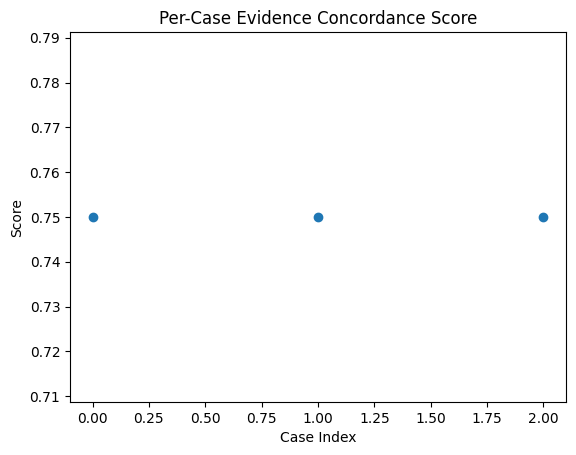
| 2 | C003 | Semantic | 0.75 | {'canonical_id': 'ACC_AHA_HTN_2022_ACE1'} |
2.8. Scoring & Aggregation
Here we convert per-case labels into headline metrics.
Binary concordance counts Exact and Semantic as concordant and reports the overall percentage.
Weighted score averages label weights (configurable via
WEIGHTS) to provide a single summary index.We also include a label distribution to show how often each category occurs.
The summarize() function aggregates these values across all cases, returning a compact table with:
total
n_cases,% cases concordant (Exact + Semantic),mean_weighted_score, anda JSON-style
label_breakdownfor quick QA and reporting.
[15]:
def summarize(results_df: pd.DataFrame) -> pd.DataFrame:
    n = len(results_df)
    pct_concordant_binary = (results_df["label"].isin(["Exact", "Semantic"]).mean() * 100.0) if n > 0 else 0.0
    mean_weighted = results_df["score"].mean() if n > 0 else 0.0
    breakdown = results_df["label"].value_counts(normalize=True).to_dict() if n > 0 else {}
    return pd.DataFrame({
        "n_cases":[n],
        "pct_concordant_binary":[pct_concordant_binary],
        "mean_weighted_score":[mean_weighted],
        "label_breakdown":[breakdown]
    })

summary = summarize(results)
summary
[15]:
| n_cases | pct_concordant_binary | mean_weighted_score | label_breakdown | |
|---|---|---|---|---|
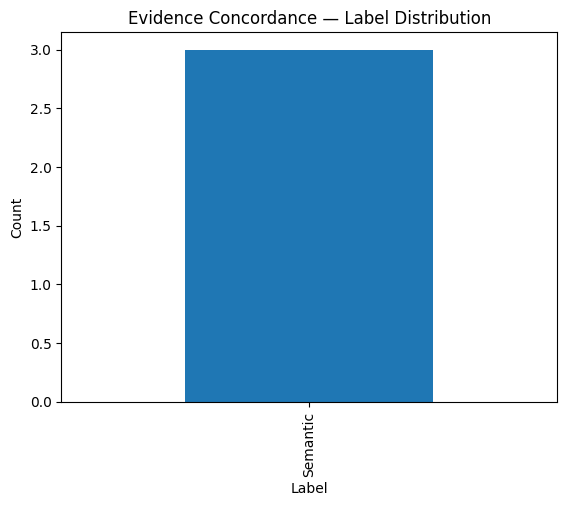
| 0 | 3 | 100.0 | 0.75 | {'Semantic': 1.0} |
2.9. Reporting & Visuals
This section provides quick visuals for QA and stakeholder review:
A bar chart of the label distribution (Exact / Semantic / For-consideration / Not) to spot mismatch patterns.
A per-case score plot to see spread, outliers, and any clustering by case index.
[16]:
# Bar chart: label distribution
label_counts = results["label"].value_counts().sort_index()
plt.figure()
label_counts.plot(kind="bar")
plt.title("Evidence Concordance — Label Distribution")
plt.xlabel("Label")
plt.ylabel("Count")
plt.show()

# Scatter: score by case
plt.figure()
plt.scatter(range(len(results)), results["score"])
plt.title("Per-Case Evidence Concordance Score")
plt.xlabel("Case Index")
plt.ylabel("Score")
plt.show()
2.10. Audit Tables & Exports
This section produces a transparent audit view and saves machine-readable outputs:
Audit table: joins each case’s guideline ID/text/version with the model’s top recommendation and any cited guideline references, plus the final label and score. Use this to spot false positives/negatives and verify mapping logic.
Exports: writes a compact JSON summary and two CSVs (results and audit) into
outputs/for downstream dashboards or CI checks.
Files written:
outputs/evidence_concordance_summary.json— headline KPIs (n_cases, % concordant, mean score).outputs/evidence_concordance_results.csv— per-case labels and scores.outputs/evidence_concordance_audit.csv— side-by-side guideline vs. model details for human review.
[17]:
# Join back key columns for a readable audit
audit = results.merge(evidence_key[["case_id","guideline_id","guideline_text","version","strength"]],
                      on="case_id", how="left")

# Show side-by-side: top prediction text/refs for transparency
def pick_top_pred_text(cid: str) -> Dict[str, Any]:
    preds = model_outputs[model_outputs["case_id"] == cid].copy()
    if preds.empty:
        return {"top_pred_text": None, "top_refs": []}
    preds.sort_values(["rank", "confidence"], ascending=[True, False], inplace=True)
    r = preds.iloc[0]
    return {"top_pred_text": r.get("pred_text"), "top_refs": r.get("references", [])}

tops = [pick_top_pred_text(cid) for cid in audit["case_id"]]
audit["top_pred_text"] = [t["top_pred_text"] for t in tops]
audit["top_refs"] = [t["top_refs"] for t in tops]

display(audit)

# Export JSON + CSV
export_dir = "outputs"
os.makedirs(export_dir, exist_ok=True)

summary_path = os.path.join(export_dir, "evidence_concordance_summary.json")
results_path = os.path.join(export_dir, "evidence_concordance_results.csv")
audit_path   = os.path.join(export_dir, "evidence_concordance_audit.csv")

with open(summary_path, "w", encoding="utf-8") as f:
    json.dump(json.loads(summary.to_json(orient="records")), f, indent=2)

results.to_csv(results_path, index=False, encoding="utf-8")
audit.to_csv(audit_path, index=False, encoding="utf-8")

print("Wrote:")
print(" -", summary_path)
print(" -", results_path)
print(" -", audit_path)
| case_id | label | score | meta | guideline_id | guideline_text | version | strength | top_pred_text | top_refs | |
|---|---|---|---|---|---|---|---|---|---|---|
| 0 | C001 | Semantic | 0.75 | {'canonical_id': 'ADA_2024_9_4'} | ADA_2024_9_4 | Start metformin for T2D unless eGFR<30 | ADA_2024 | Strong | Start metformin | [] |
| 1 | C002 | Semantic | 0.75 | {'canonical_id': 'NCCN_BR_2025_A1'} | NCCN_BR_2025_A1 | Avoid NSAIDs in stage 4-5 CKD | NCCN_2025 | Strong | Avoid NSAIDs | [] |
| 2 | C003 | Semantic | 0.75 | {'canonical_id': 'ACC_AHA_HTN_2022_ACE1'} | ACC_AHA_HTN_2022_ACE1 | Use ACE inhibitor for hypertension | ACC_AHA_2022 | Strong | Start ACE inhibitor | [] |
Wrote:
 - outputs\evidence_concordance_summary.json
 - outputs\evidence_concordance_results.csv
 - outputs\evidence_concordance_audit.csv
2.11. Appendix: Helper Utilities
Patient-feature gates (e.g., skip metformin if eGFR < 30).
Version-drift policies (treat 2023 vs 2025 guideline IDs as “For-consideration”).
Inter-rater checks (e.g., Cohen’s κ for manual labels).
Conversion helpers (e.g., map three-bucket labels → binary).
Keeping this section isolated ensures the core evaluation pipeline stays clean, while still leaving space for modular extensions later.
[18]:
# Placeholder for future helpers, e.g., patient-feature gating, version drift policies,
# or inter-rater agreement scaffolding.
#
# Example: simple policy to map three-bucket labels to a binary for headline reporting
def to_binary(label: str) -> int:
    return 1 if label in {"Exact","Semantic"} else 0